
Terapkan Smart Farming Agroteknologi UMM, Potensi Wisata Petik Melon Bagi Masyarakat
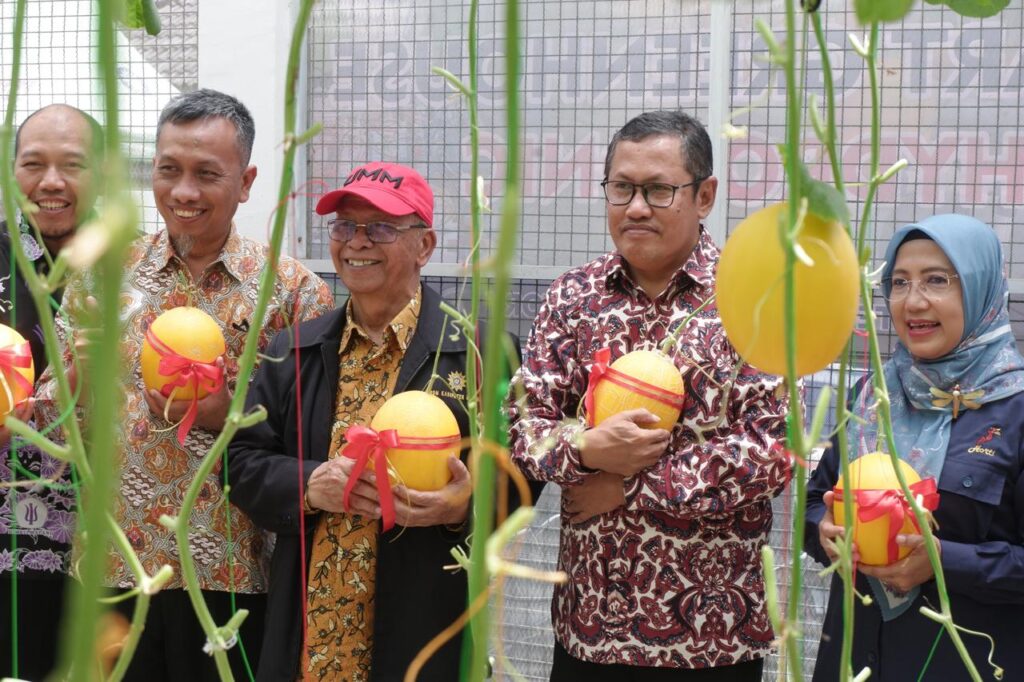
Laboratorium Program Studi (Prodi) Agroteknologi Universitas Muhammadiyah Malang (UMM) Laboratorium Program Studi (Prodi) Agroteknologi Universitas Muhammadiyah Malang (UMM) melakukan kegiatan open greenhouse petik melon dengan teknologi smart farming pada 25 Januari 2025 lalu. Kegiatan tersebut merupakan upaya pemanfaatan lahan edupark milik UMM sekaligus sebagai tempat wisata bagi masyarakat umum. Open greenhouse petik melon tersebut mengundang oleh Prof. Dr. Nazaruddin Malik, SE., M.Si selaku Rektor UMM, Drs. Wakidi selaku Wakil Ketua BPH, Ir. Hj. Sunarti, M.M selaku Kepala Dinas Pertanian Provinsi Kalimantan Tengah, Toha Mashuri, S.Sos, M.M selaku Kepala Dinas Pertanian Kabupaten Blitar, serta Jajaran Kepala Dinas Pertanian Kota dan Kabupaten Malang. Muhidin selaku Kepala Laboratorium Edupark UMM menjelaskan bahwa smart farming dapat mengefisiensi waktu. Keunggulan smart farming terletak pada pengendalian jarak jauh menggunakan aplikasi di gawai yang memiliki program khusus untuk membantu pemberian nutrisi pada tanaman melon. “Jadi, aplikasi yang kami buat itu bisa memungkinkan penyiraman secara otomatis dan dapat dikendalikan jarak jauh. Kita tinggal mengatur nutrisi agar tanaman dapat ternutrisi dengan baik,” tutur Muhidin. Sebagai informasi, UMM menanam melon jenis Intanin dan Lavender dengan sistem hidroponik dan fertigasi dan alokasi waktu tanam selama 70 hari atau tiga bulan. Melon jenis ini memiliki ciri khas buah berwarna kuning cerah, tekstur lebih renyah, lebih berair, dan memiliki rasa yang manis ketika matang. Menurut Muhidin metode fertigasi dan hidroponik dipilih karena memiliki keunggulan dalam pemberian nutrisi. Metode ini memiliki efisiensi pemberian nutrisi sehingga mudah diserap oleh tanaman. Selain itu, pencahayaan pada tanaman juga dapat mempengaruhi percepatan pertumbuhan. “Permasalahannya itu terletak pada minimnya cahaya alami yang masuk karena dikelilingi gedung cukup tinggi. Tapi hal tersebut kami atasi dengan mengganti material atap greenhouse agar cahaya dapat masuk dengan maksimal,” tambahnya. Rektor UMM, Prof. Dr. Nazaruddin Malik, SE., M.Si menyampaikan bahwa perguruan tinggi harus mengambil peran untuk menjawab persoalan praktis di masyarakat. Salah satunya melalui smart farming yang diterapkan dapat menjadi solusi bagi masyarakat dan menjawab tantangan ketahanan pangan mandiri di masa mendatang. “Pengembangan smart farming ini harus terus dilakukan untuk meningkatkan kualitas hasil pertanian. Selain dari segi efisiensi waktu, smart farming seperti ini dapat menjawab kebutuhan masyarakat yang tidak memiliki banyak waktu untuk bercocok tanam di kebun,” ujarnya. Terakhir, Nazaruddin berharap bahwa kegiatan open greenhouse petik melon ini dapat memberikan manfaat bagi semua pihak. Ia juga berpesan agar inovasi smart farming yang dilakukan UMM tidak hanya menunjukkan komitmen perguruan tinggi kepada masyarakat dan stakeholder, namun juga selaras dengan program pemerintah dalam memperkuat ketahanan pangan.
Dosen UMM Temukan Farm Mapper
Kota Malang, Bhirawa Dosen Fakultas Pertanian dan Peternakan (FPP) Universitas Muhammadiyah Malang (UMM), Wahono menemukan cara spektakuler untuk pemetaan lahan dan penyebaran bibit di daerah yang sulit dijangkau manusia. Wahono, menciptakan pesawat tanpa awak (drone) yang diberi nama Farm Mapper. Kandidat Doktor Universitas Gajah Mada (UGM) ini merancang sendiri alat-alat tersebut untuk menyelesaikan disertasinya dengan fokus pada inovasi yang mendukung kebutuhan pupuk untuk tanaman di area yang sangat luas. Awalnya ia hanya ingin membeli pesawat sejenis untuk mendukung disertasinya. Namun karena harganya sangat tinggi, lebih dari Rp 700 juta, muncullah ide untuk menciptakan drone sendiri. “Untuk membuat pesawat ini, saya harus menguji coba ulang dengan memodifikasi dari model pesawat tanpa awak sejenis yang sudah ada sebelumnya,” ungkapnya. Dengan background keahlian di bidang teknologi informasi, drone yang dikembangkan Wahono diyakini memiliki teknologi high resolution real time. Pesawat ini mampu memetakan (mapping) wilayah hingga luas 800 sampai 900 meter sekali terbang dalam waktu dua jam. “Hal ini tentu membuat proses pemetaan lahan jadi jauh lebih efektif dan efisien. Kalau harus mengukur satu persatu ke lapangan membutuhkan waktu lama dan mengeluarkan biaya yang sangat tinggi,” kata dia. Mantan kepala Unit Pelaksana Teknis (UPT) Komputer UMM ini, menyatakan Farm Mapper menggunakan sensor canggih yang mampu memetakan area luas tanpa menggunakan remote control. “Kita tinggal program pesawat ini mau terbang ke area mana yang akan kita mapping, sambil melihat proses pemetaan di front station pada layar komputer, sampai dia kembali lagi,” terangnya. Hasil pemetaan yang diperoleh tadi langsung terunggah di komputer yang telah dipasang aplikasi khusus. Data tersebut bisa direkonstruksi dalam model 2D dan 3D. Selain untuk bidang pertanian, Wahono menuturkan, Farm Mapper juga bisa digunakan untuk pemetaan terumbu karang dibawah permukaan laut pada pulau-pulau kecil. Diakui dia, banyak kendala yang ia hadapi saat proses uji coba, mulai dari hal teknis sampai hilang saat pesawat jatuh. “Seperti saat hujan deras, pesawat yang kita terbangkan terjebak dan hanya bisa berdiam di udara hingga baterainya hampir habis. Saat hujan reda, pesawat memang bisa kembali terbang normal,” tuturnya. Namun karena baterai hampir habis pesawat tidak sampai kembali ke orbit awal dan akhirnya pesawat yang ia buat dengan biaya sekitar 20 juta itu pun jatuh. “Waktu itu tempat jatuhnya berjarak sekitar 2 km, saat saya mau ambil ternyata sudah hilang,” tuturnya. Kedepan, Wahono berencana mempercanggih drone ciptaannya itu. Ia akan menambahkan sensor collision avoidence dan route alternative yang mampu menghindari tabrakan pesawat dari objek tak terduga didepannya hingga pesawat mampu mengubah arah secara otomatis. [mut] Author by Helmy SupriyatnoPosted on 12/04/2016 Sumber : http://harianbhirawa.co.id/2016/04/dosen-umm-temukan-farm-mapper/
Curriculum Workshop Based on KKNI Agriculture and Husbandary Faculty
There are no one of the participant stood on their sits since the beginning until the end of agenda. The interesting and important material, then high commitment in developing institutions and alumni, and also the delivery of fun material from the spokesperson, Ir. Endrotomo, MSc became the reasons. The curriculum workshop based on KKNI (Curriculum Qualification of Indonesian Nation) was important to do because UMM Agriculture and Husbandry Faculty (FPP) wants to ensure and improve the quality of education, in order to assure the work world about the quality of labor candidates due of the curriculum based on KKNI which has the purpose to give the qualification towards individual according to their learning accomplishment. By this KKNI-based curriculum, the graduate students of local state and private universities will be equal with the graduates from universities abroad, considering that KKNI has been approved internationally. Thus, the accreditation criteria for university and study program will also be based on KKNI. The evaluation of curriculum will be executed gradually in faculty and study program level. The evaluation and preparation will involve all units such as similar study program, associated expert group, profession organization, government, and alumni’s employers. After graduated, the alumni will not only get diploma and transcript during college period, but they also obtain Certificate Diploma Companion which consists of the note on all ability and achievement of the FPP graduate.
Agung Irawan Animal Husbandry Department Achieve International Achievement through Jenesys 2.0 Progra
Again, Faculty of Agriculture and Animal Husbandry UMM created the achievement in international level. This time Agung Irawan the student of Animal Husbandry Department who got chance to visit Japan through Jenesys 2.0 (Japan-East Asia Network of Exchange for Students and Youth). This program that was followed by 96 students from around Indonesia will be run in 2 weeks (23/02-04/03). According to Agung, selection process to be accepted in that program consists of two steps those are administration selection and direct interview via telephone. He said more than 2000 registrant who followed this selection program. “In first step the committee selected 150 the candidate best participants from all registrant, then in interview step the committee set 96 elected participants,” said that eighth semester student. Furthermore, the student who ever hold the predicate third winner achiever student UMM level explained, Jenesys program purposed to strengthen the basic of diplomatic relation between Japan and each Asian countries and Oceania. This program fully financed by Japan government, and conducted by Japan International Cooperation Center (JICE) and Japan ambassador in Indonesia and The Community University of Islam Negri Syarif Hidayatullah Jakarta (PPIM UIN Jakarta) as selection team. While in Japan, the participant will participate some activity there are visit to some Japan companies to know exactly about cutting edge with high technology that to be developed and to know more closely about “made in Japan”, visit to some province in Japan to improve the understanding about cultural power, attraction, and local value in Japan, and visit historical architecture, religious building, and world heritages in Japan. “This program is also purposed as the process of internationalization some areas in Japan by emphasizing youth as human resource,” he added.
Riza Rahman Hakim Reveals The Potency of Castor Oil Seed as Fish Feed
Nowadays, the seed of castor oil (jarak) is commonly used as the ingredients for fuel. However, it turns out that the waste can be recycled to become the ingredients for fish feed of protein economically. Reza Rahman Hakim S.Pi, M.Sc., the Animal Husbandry Dept. lecturer has proven through his research. Due of his discovery, the Bojonegoroan lecturer successfully holds the Master of Science title in the Department of Aquaculture, Kasetsart University, Thailand. The idea appeared when seeing the reality of Indonesia that lacking the energy source from fish feed. According to Reza, bungkil/oil cake (from soybean) and fish flour as the protein source currently are getting hard to find and the existence compete with the human needs. Based on this, he continued, the existence of fish feed ingredients of protein source that can replace the function of the expensive bungkil is necessary. “After straining the oil, the waste of those seed is dumped and not useful. It turns out that this waste is able to replace 75 % of soybean flour, of course it’s very efficiency and economic,” said by the achiever of abroad scholarship from Dikti. Moreover, he explained that in order to be a feed, the oilcake of jarak seed must be detoxified prior in order to remove its contents of toxin and anti-nutrients substances. On this process, he built cooperation with Chemistry Department of Kasetsart University. The result showed that the content of crude protein from the jarak seed oilcake is almost equal with the soybean oilcake. “It turned out that the contents of amino acid in the jarak seed oilcake is also better than soybean oilcake”, added by the lecturer who got the best presenter for young lectures’ research by Kopertis VII. According to him, jarak seed oilcake is still very rare to be applied in Indonesia. It makes him sure about its big potential to be developed. In the future, he plans to continue in developing his research until it can be used widely in fishery field. “If UMM will expand the unit production of jarak seed biodiesel, of course it becomes the strategic way to continue its expanding so that it can be truly integrated and zero waste,” he said. Through his study in the White Elephant country, he also explained that its advancement in managing fishery farming sector must be exemplary for Indonesia. All fishermen of small until industrial scales already apply good fish farming procedure or Good Aquaculture Practice. Moreover, the good relationship between university and stakeholder can be seen clearly. “The university has become the stakeholder’s reference in providing quality fish,” he said. (agung/t_iqa)
Agriculture and Husbandary Faculty Passes 17 Graduates
Again, The Faculty of Agriculture and Animal Husbandry graduated 17 the candidate of graduates in 71st graduation agenda, first period in 2014. Judicium procession for the candidate of graduate was held in FPP courtroom (15/02). Before the procession is begun, FPP gave soft skill equipment as the form of responsibility and effort to create the competent graduate and ready to fight. In that event, was attended by Yudi Suharsono S.Psi, M.Si psychology expert from UMM as trainer that gave the material about soft skill development and tips to enter world work. Through his material, the candidate of agriculture and animal husbandry graduate was asked do not be the failed product. According to him, one problems of university graduate is less confident. “Most of them not confident so cannot compete, so to know self-potency is very important,” said Vice Dean I Faculty of psychology UMM. While, the Dean of FPP, Dr. Ir, Damat, M.P, he proud of judicium this period, there were 5 candidates of graduate that able finished faster 3 years 6 months. According to him, it is the greatest achievement with the GPA that near to perfect. However, he hope who got the greater GPA more motivated to improve their achievement. He added, the final of study do not be the end of learning. “The great GPA is plus value but not guarantee, so use the plus value and balance with good soft skill ” he said. As the previous years, FPP always gave the award to the higher GPA. In this time, FPP assigned three the higher GPA that was achieved by Moh. Khoirul Hidayat from department of fishery with GPA 3.95, Jefri Lukmana Lazaroni from department of fishery with GPA 3.93, and Gharisa Kharismartanata from Department of Forestry with GPA 3.90.(agung)
PUBLIC VOCATIONAL HIGH SCHOOL 10 MALANG DEVELOPS AGRICULTURAL ENTREPRENEURIAL SPIRIT
MALANG – Surrounded by fertile soil and plenty of water makes Indonesia has a big chance to show its gait in agriculture. In terms of economics, agriculture can be done by people from the lowest level of economics until elite community. This becomes an important point that makes the students of Public Vocational High School (SMKN) 10 Malang join agricultural entrepreneurial motivation and development by a lecturer of Agriculture Faculty of University of Muhammadiyah Malang (UMM), Rachmad Pulung Sudibyo, SP.MP on Friday (10/1), yesterday afternoon. Began with audio-visual activity, the students enjoyed together educative show in the school hall. Next, no less than one hundred students got field motivation and theories about agricultural entrepreneurship. “Rachmad Pulung Sudibyo, SP.MP was trusted to develop entrepreneurship at UMM and the community, mainly in youth community of Kelurahan Gadang. We are sure that our students will be inspired from him to realize their entrepreneurial spirit in agriculture,” Headmaster of Public Vocational High School 10 Malang,” Drs. Haryanto, MPd, said. Entrepreneurship focus that is applied at Public Vocational High School 10 Malang is vegetable cultivation such as eggplant, broccoli, tomato, and chilli. At this time, that business has been developed in school garden and and polybags around school building located at Malang International Education Field (MIEF). “Entrepreneurship is inseparable from education, mainly vocational education. Without entrepreneurial spirit, the materials delivered by the teachers in class will not be useful,” Haryanto explained. Next, Haryanto said, Public Vocational High School 10 will hold partnership with UMM to make his students’ entrepreneurial program can be conducted continuously. Besides, this friendly man also said that he would have project on the business of rabbit, eel livestock, etc. which are suitable with the needs of the people. Including tofu that is fermented with seawater essence that now is still in completion phase. (ily/nda)
VACATIONAL HIGH SCHOOL 10 MALANG JOINS UMM IN DEVELOPING SCHOOL FARM
MALANG – Who said that urban societies are unable to farm? With the knowledge, the less of farmland is no longer a constraint. As being worked by State Vocational High School 10 Malang called School Farm program. By maximizing the dwindling land potential, the management of State Vocational High School 10 Malang is expected to fill out all empty land around the building with productive plants. “Currently, we are planting some plants such as broccolis, beans, and manias. The School Farm development is considered well for developing students’ entrepreneurial spirit”, said by PR Vice of State Vocational High School 10 Malang, Wahyu prasadjaS Pd, to the Malang Post. In order to maximize the school farm function, Wahyu commented, the school has done some important steps. One of them is cooperating with Agriculture and Husbandry Faculty of UMM that will give counseling and agriculture training periodically. Moreover, every student’s activity will be monitored and guided since planting media decision, organic fertilizer preparation, planting technique, plants treatment until the harvest time. “We signed an MOU with the Agriculture and Husbandry Faculty of UMM who will guide the students in learning and developing organic farming in the urban,” Wahyu explained. Wahyu continued, school farm program based on the school’s objective do not only hone the students’ ability according to their competencies only, but also be skilful in other areas such as farming. Furthermore, nowadays school has learned the potential in the Kedung Kawang sub-district. From the result, it was known that there are many farming potentials can be developed in order to support food security program. For the example is Wonokoyo, there is famous agricultural production development with the organic farming village “We had discussed with the developer of organic farming village in order to help us in realizing this School Farm together. After the discussion with the citizen, we seemed like to get such positive response”. Meanwhile, in different occasion, Haryanto M Pd as the Headmaster of State Vocational High School 10 Malang explained that the planning in realizing agricultural entrepreneurship for the students has a purpose so that the school has plus value to stand amid the society in the future. (ily/nda/t_iqa)
Konsep Tradisional di FPP
Hari ketiga Pengenalan Studi Mahasiswa Baru (Pesmaba) Fakultas Pertanian dan Peternakan (FPP) diawali dengan Safari Rektor (8/9). Bersama Pembantu Rektor dan jajaran rektorat, Rektor UMM Dr. Muhadjir Effendy, MAP disambut oleh 454 mahasiswa baru dengan nyanyian selamat datang. Bertempat di Rusunawa I, acara pesmaba tersebut bertemakan “One Person, One Act, One Effect For Our Word Life”. Dalam sambutannya, Dr. Muhadjir Effendy, MAP mengucapkan selamat datang kepada mahasiswa baru yang berasal dari sabang hingga merauke tersebut. Sebagai awal, Dr. Muhadjir Effendy, MAP memperkenalkan para Pembantu Rektor beserta para jajaran dan Tupoksinya. Setelah itu dilanjutkan dengan pengenalan fasilitas dan bidang kerjasama yang ada di UMM. “Manfaatkan fasilitas yang ada di UMM. Dan tunjukkan bahwa anda semua disini bangga menjadi mahasiswa UMM, pertahankan nilai baik,” ujar Dr. Muhadjir Effendy, MAP. Kali ini Pesmaba FPP menggunakan konsep alam. Dekorasi yang terpajang pada panggung menunjukkan pemandangan alam pedesaan. Dilengkapi dengan gubuk dan properti pedesaan, FPP menunjukkan kedekatannya dengan alam. “Kami (panitia.red) ingin mengajak para mahasiswa baru dekat dengan alam. Pada safari jurusan, kami mengajak para maba untuk berkeliling ke laboratorium dan lahan yang merupakan fasilitas FPP,” ungkap Wisnu Mukti selaku ketua panitia. Hal yang membedakan dengan tahun lalu juga terletak pada acara hiburan yang mana kali ini FPP mengundang stand up comedy. Tahun ini FPP menerima mahasiswa baru dari Agroteknologi 110 mahasiswa, ITP (Ilmu Teknologi Pangan) 108 mahasiswa, Peternakan 86 mahasiswa, Agribisnis 84 mahasiswa, Perikanan 46 mahasiswa, dan Kehutanan 20 mahasiswa. lia